A WhatsApp AI chatbot fails in two directions. Keyword rules are predictable but stupid: someone writes "how much does it cost to cancel" and the price list fires. Pure AI is smart but unpredictable: it will confidently answer a question about your refund policy that it invented.
Spun separates the two decisions. A rule decides whether to respond at all, and to what. The AI decides how to word it. Both halves are configurable, and either can be dialled down to nothing, which is what makes it safe to switch on for a real customer inbox.
What can start a reply
A rule begins with a trigger, and the range of triggers is what lets you be specific rather than blanket.
- A keyword, or a full regular expression when a keyword is too blunt.
- A first contact: the very first message from someone you have never spoken to.
- Outside business hours, which is the classic away message and the one most teams start with.
- A label, so a rule applies only to conversations already tagged a certain way.
- Everything, when you genuinely want every inbound message considered.
- Being a campaign recipient, so a reply to a broadcast is handled differently from a cold enquiry.
- Arriving through a specific smart link, so the answer can match the thing they clicked.
- AI intent: the message means something, whether or not it contains any particular word.
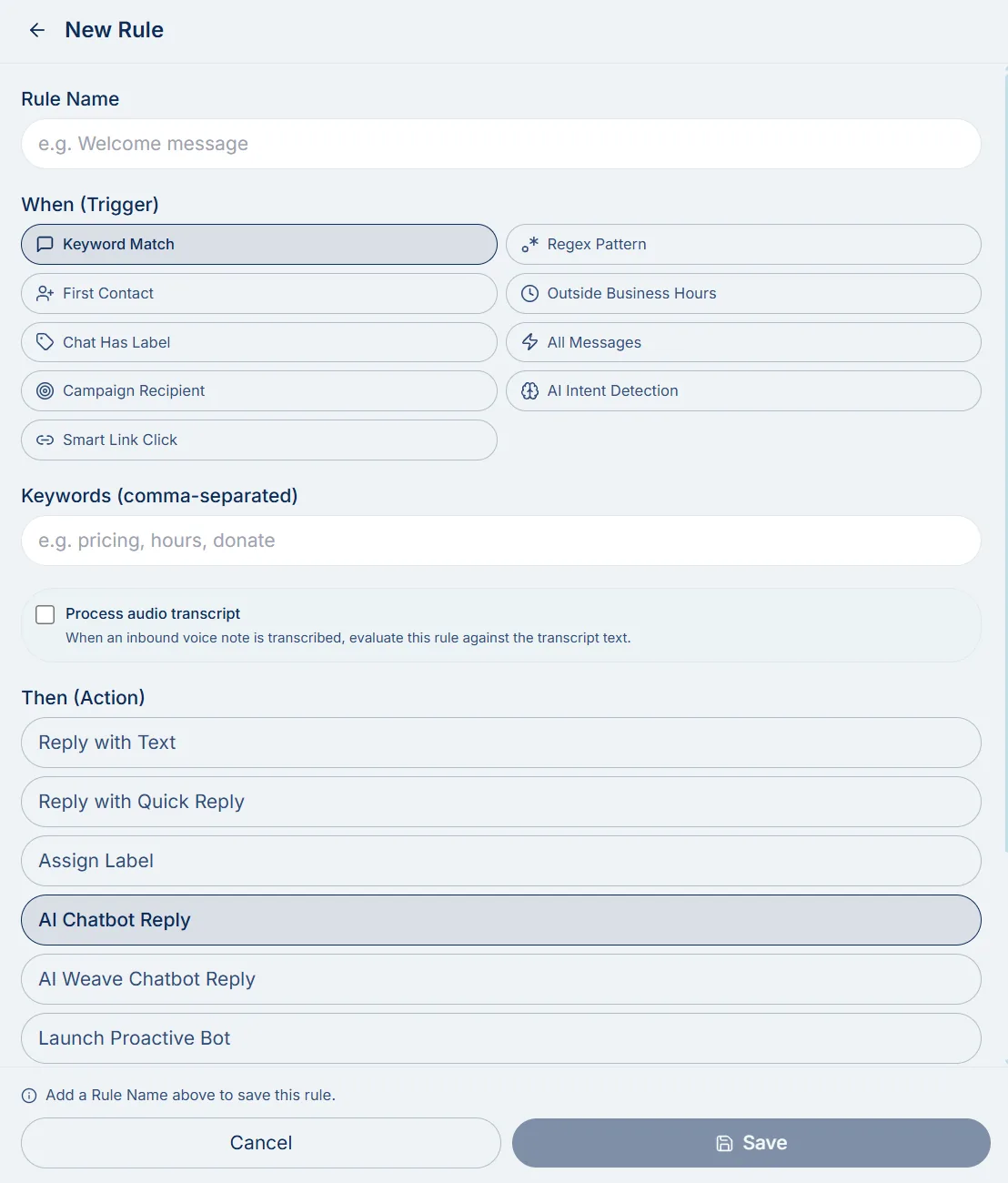
Rules carry an explicit priority, and you decide whether a match stops there or lets later rules run too. That ordering is what stops the away message and the pricing reply from both landing at 9pm.
Related: Links that trigger a specific reply
The guardrails that make it usable
Most auto-reply disasters are not wrong answers. They are the same answer four times in ten minutes, or a rule from a campaign three months ago that nobody turned off. The controls below exist for exactly those failures, and they are per rule.
- A cooldown, so the same rule cannot answer the same conversation repeatedly. A minimum cooldown applies even to a rule that sets none.
- Daily and lifetime caps on how many times a rule may fire at all.
- An expiry date, or a number of days to stay active, so a campaign rule turns itself off.
- Label include and exclude lists, so a rule can be kept away from VIPs or from anything a human has already claimed.
- A human-like delay before replying, drawn from a range, so answers do not arrive in the same half-second the message did.
- Wording variation, so a hundred people asking the same thing do not all receive a byte-identical sentence.
What a WhatsApp AI chatbot should and should not answer
The most useful control here is the confidence gate, and it is worth understanding because it is the thing that makes a keyword rule stop being stupid. A rule can require that the AI classify the message as genuinely matching the intent, with a confidence you set, before it is allowed to fire. Below your threshold, the rule stays quiet and the message reaches a human like any other.
That turns "reply when the message contains the word price" into "reply when the message is actually asking about price, and the AI is at least this sure". The customer asking how much it costs to cancel no longer gets the price list.
A rule that is gated on confidence and never fires is telling you something real: the threshold is too high, or the intent is too vague to automate. Both are better discovered by silence than by a bad reply.
Suggesting instead of sending
The safest version of this feature does not send anything. Alongside auto-reply rules, Spun offers suggested replies: the AI drafts an answer in context and presents it in the conversation, and a person sends it, edits it first, or ignores it. The suggestion is visibly a suggestion until someone acts on it.
For most teams that is the right place to start. You get the speed benefit on the ninety percent of messages that have an obvious answer, without ever handing the account to a machine. Once you can see which questions the AI drafts well every single time, those are the ones worth promoting into a real auto-reply rule.
Related: Every AI feature in Spun
When a single reply is not enough
- Chat flows: branching conversations with conditions and actions, for booking or onboarding sequences that need more than one exchange.
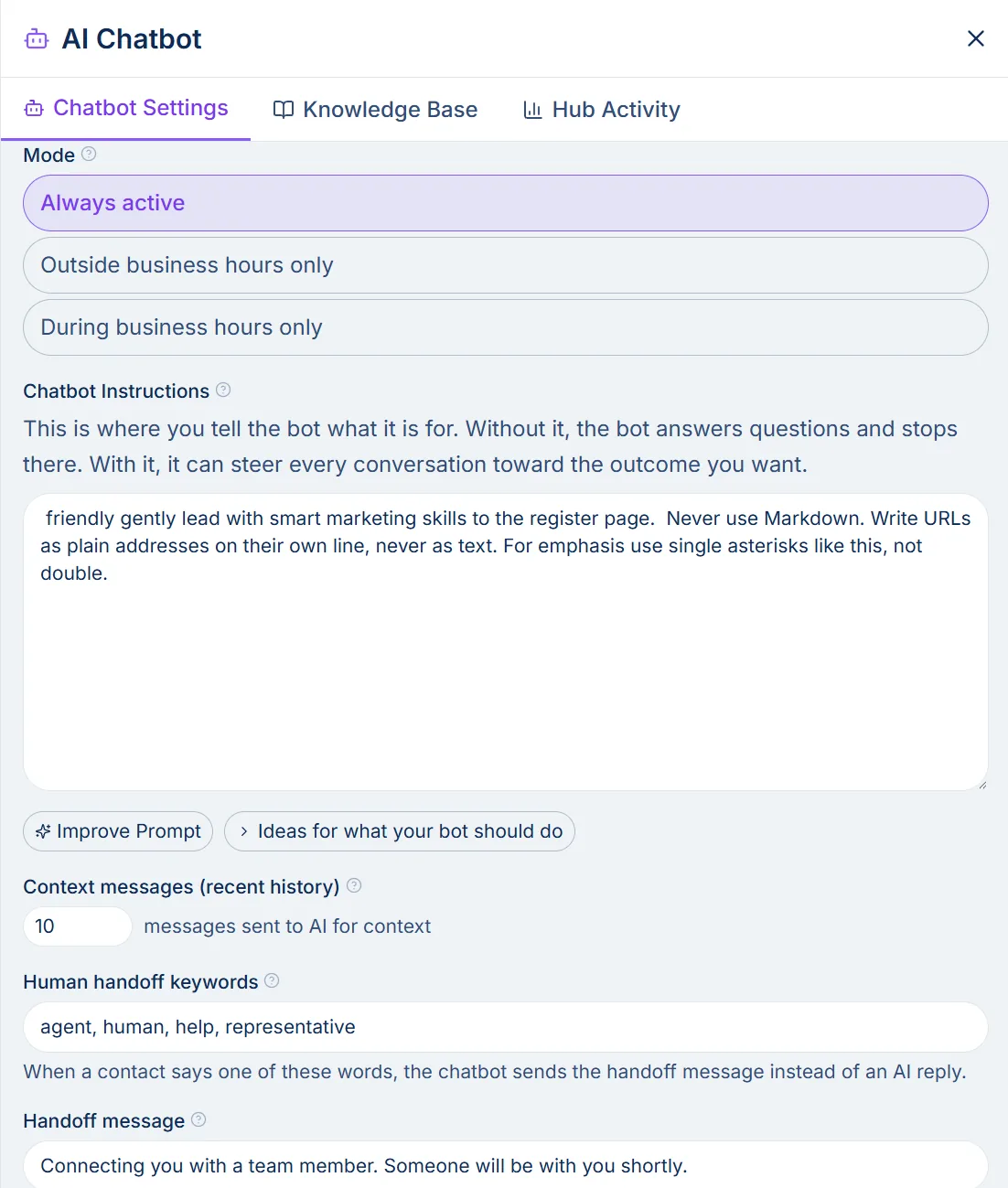
- Knowledge base: upload your documents and FAQs so the AI answers from your own material instead of from general knowledge.
- Autopilot: routine conversations handled end to end, with a confidence threshold and handoff rules so it escalates when it is unsure.
- Voice: a rule can act on the transcript of a voice note, and can reply as a voice note rather than as text.
Before switching any of it on for real traffic, shadow mode runs an automation without sending anything so you can read what it would have said, and conflict detection warns you when two rules would fire on the same conversation.
Related: How auto-translation handles a customer in another language
Limits and honest cautions
- An auto-reply is still a message from your number. Everything it sends carries your business's reputation, and WhatsApp's rules apply to it exactly as they do to a human message.
- AI replies use your plan's AI allowance. High-volume automation is a real cost line, not a free one.
- A confidence gate reduces wrong answers, it does not eliminate them. Anything with money, legal or medical consequences belongs behind a human.
- Rules only see what reaches the inbox. A rule cannot answer a message on a line that is disconnected.
- More rules is not better. Two well-scoped rules with sensible cooldowns beat nine overlapping ones, which is why conflict detection exists at all.
Related: What each plan includes